
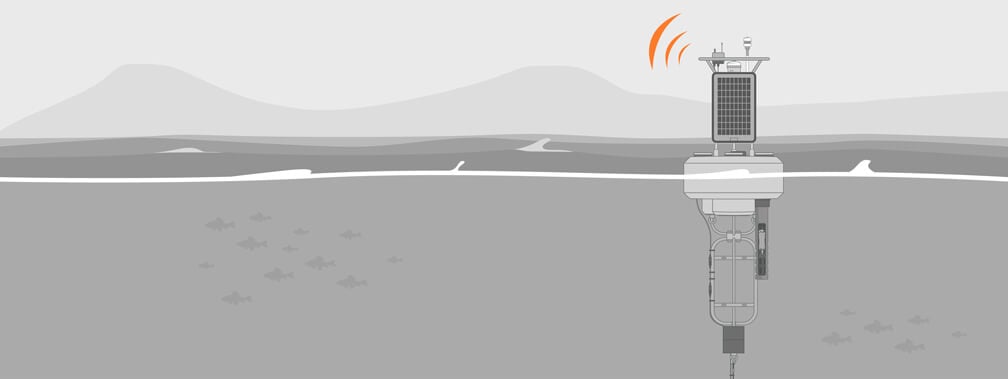
Open water buoys, also referred to as data buoys, provide a stable, floating platform for deploying environmental monitoring instruments in lakes, rivers, reservoirs, estuaries, bays, and coastal or ocean waters. These systems are essential for collecting real-time data in locations that may be difficult or dangerous to access using traditional methods.
Buoys can support a wide range of sensors–both above and below the waterline–and are typically moored in place, although drifting configurations are also possible. Instrumentation can include meteorological sensors, thermistor strings, water quality sondes, current profilers, wave sensors, and others. Many are equipped with solar panels for battery charging and telemetry devices for remote data transfer.
These platforms support continuous, unattended monitoring and can reduce the need for frequent field visits. They are commonly painted yellow to indicate scientific activity and may include various markings, such as navigation lights and radar reflectors, to maintain visibility for boat and ship traffic.
Why Choose Open Water Buoys?
Open water environments present significant challenges for manual data collection, including logistical constraints, equipment transport challenges, and safety concerns. Data buoys provide a practical solution for continuous monitoring and offer several distinct advantages:
- Remote, Unattended Deployment: Buoys eliminate the need for repeated trips by boat, enabling high-resolution data collection in remote locations with limited access.
- Versatile Instrumentation: Buoys can accommodate a mix of topside and subsurface sensors to monitor a wide range of variables related to weather, water quality, and sea state.
- Real-Time Data Acquisition: Buoys equipped with integrated telemetry allow for near real-time data access, typically via cellular, satellite, or radio communications.
- Flexible, Strategic Placement: Buoys can be positioned at critical locations, such as above drinking water intakes, within protected habitats, or in navigation channels, with minimal interference to operations and ecosystems.
- Ease of Transport and Setup: Many modern buoy platforms are designed for one or two-person deployment without cranes or large vessels, thereby expanding deployment options.
These factors make buoy platforms a flexible solution for a variety of research, monitoring, and operational applications. They are an ideal choice for environmental projects requiring continuous, remote data collection in open-water settings.
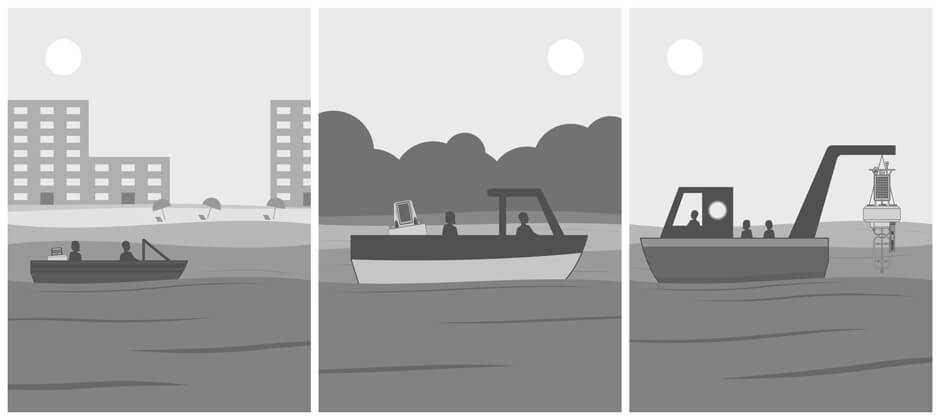
Depending on the deployment site, power requirements, and instrumentation, different-sized buoys may be needed. Smaller buoys may be able to be transported and deployed by a single person, while larger models require lifting gear.
Considerations for Open Water Buoys
Effective buoy system design begins with an understanding of site-specific conditions and project requirements. Several factors must be evaluated when selecting a buoy platform:
- Site Conditions: Variables such as water depth, wave energy, current velocity, ice loading, and potential debris loads influence the selection of buoy size and mooring strategy.
- Buoyancy & Payload: Buoy buoyancy must accommodate not only the site conditions but the weight of all equipment, including batteries, sensors, telemetry hardware, and navigation aids. Net buoyancy and freeboard should remain sufficient even under biofouling, high winds, or wave loading. Ballast weight may be required for stability under varying conditions.
- Power Supply: Solar-charged batteries are commonly used to support long-term operation. Solar panel size and battery capacity must align with power draw and available sunlight. A power budget analysis helps in sizing the solar array.
- Mooring Design: A well-engineered mooring ensures stability and system longevity. Depth, bottom type, water level fluctuations, and expected wave/storm conditions affect anchor selection, line tension, and shock load resistance.
- Sensor Mounts: Instrumentation must be mounted securely to ensure measurement accuracy and protect sensors from damage. Some buoy models are particularly well-suited for mounting of certain sensor types.
- Corrosion & Biofouling Protection: Saltwater and biofouling increase maintenance requirements. Buoys should include sacrificial anodes, anti-fouling coatings, and regular inspection schedules.
- Maintenance: Components should be relatively easy to access for periodic maintenance. Field-swappable components and modular construction facilitate servicing, while sensor mounts with topside access may allow for maintenance without removing the buoy from the water.
Careful attention to these design parameters ensures buoy platforms remain stable, secure, and functional in extended deployments and across varying conditions.

Deployments in rough seas require specialized mooring that must be prepared for in advance.
Conclusion
Open water buoy systems provide a reliable foundation for remote, high-resolution environmental monitoring. Their versatility in supporting a range of sensor types and their ability to withstand dynamic aquatic environments make them indispensable tools for continuous data collection in open-water applications.
Additional Resources

