

Soil conductivity, often referred to as electrical conductivity (EC), measures the ability of soil to conduct electrical current. This property is determined by the presence of dissolved salts and other charged particles (ions) in the soil solution.
Conductivity is directly influenced by soil moisture, temperature, and salinity, as water and dissolved ions serve as the primary pathways for electrical current flow. Higher moisture and salt content tend to increase conductivity. Conversely, colder temperatures decrease conductivity, which also drops substantially below the freezing point.
Conductivity is expressed in standard units of Siemens per meter (S/m), with smaller values common to soils given in deciSiemens per meter (dS/m). In soils, it is also commonly referred to as bulk conductivity because it represents the combined EC of all components within a given volume of soil, including the soil particles, moisture, and air pores. This differs from pore water conductivity, which can only be measured by extracting water from a slurry created from the soil and distilled water.
Why Measure Soil Conductivity?
Bulk EC is an important parameter for evaluating soil health and quality in continuous monitoring applications. It provides an indication on the relative concentrations of nutrients and salts in the soil, which in turn impact plant growth and microbial activity that is key to nutrient cycling and other soil processes. Excess salinity can inhibit plant water uptake, while optimal conductivity levels indicate sufficient nutrients and healthy soil conditions.
As such, it is particularly important to agriculture, horticulture, hydroponics, turf/landscape management, and any other application related to plant growth. Soil EC monitoring can help optimize irrigation/watering and fertilizer application, as well as identify potential salinity issues so that remedial action can be taken before they negatively impact plant health.
In addition to plant growth applications, soil EC measurements can be useful for contamination detection, for example, near industrial facilities, mines, or landfills with suspected leaching. Conductivity data can aid both in detecting and assessing the movement of dissolved salts through soils or in groundwater recharge zones.
Finally, soil EC measurements can help to verify soil moisture readings, particularly for capacitance-based soil moisture measurement technologies that are subject to error in high-conductivity soils.
How Is Soil Conductivity Measured?
Sensors for continuous, in situ measurement of soil conductivity typically measure bulk EC (that is, the EC of the soil-water-air matrix). Many of the same technologies used for soil moisture measurement can also be adapted to estimate bulk EC. This includes sensor types based on capacitance, time-domain reflectometry (TDR), and dielectric impedance.
Capacitive sensors generate an oscillating electric field between two electrodes placed into the soil. By analyzing the soil’s charge-storing capacity (capacitance), they can determine the dielectric permittivity, which is primarily influenced by soil moisture. Bulk EC can then be estimated using a calibration, as increased ionic conductivity in the soil solution contributes to changes in the electrical properties measured by the sensor.
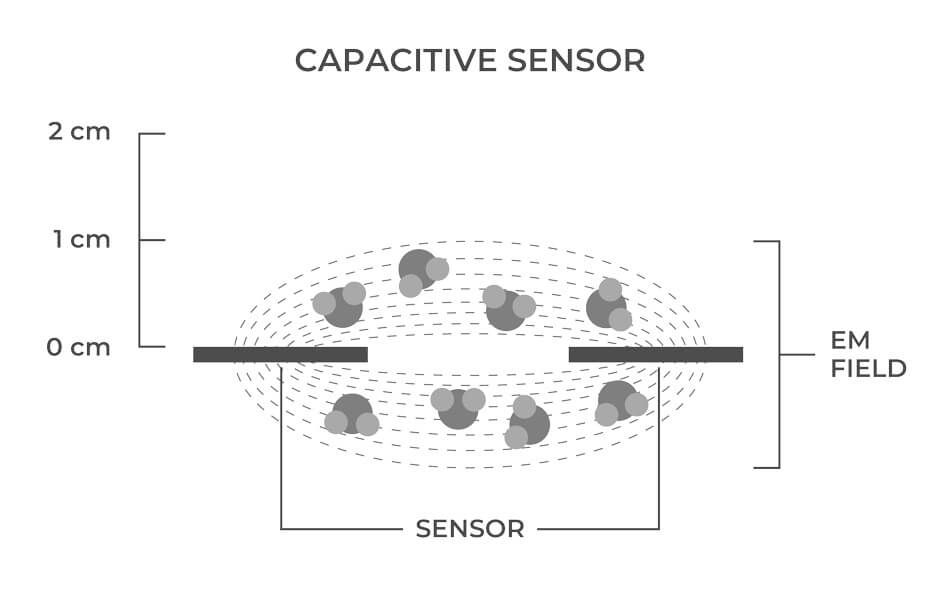
Capacitive sensors measure for dielectric permittivity and then apply a calibration to determine soil conductivity.
TDR sensors measure bulk EC by sending an electromagnetic pulse through the soil and analyzing how the signal is attenuated. The attenuation (signal loss) increases with higher concentrations of dissolved salts in the soil solution, thereby indicating greater electrical conductivity.

Signal attenuation of TDR systems can provide an indication of soil bulk EC.
Dielectric impedance sensors measure bulk EC by applying a high-frequency electrical signal through prongs inserted into the soil, measuring the soil’s dielectric constant via impedance (electrical resistance). Advanced signal analysis can identify energy losses caused by ionic conduction, which are directly linked to soil salinity and conductivity.
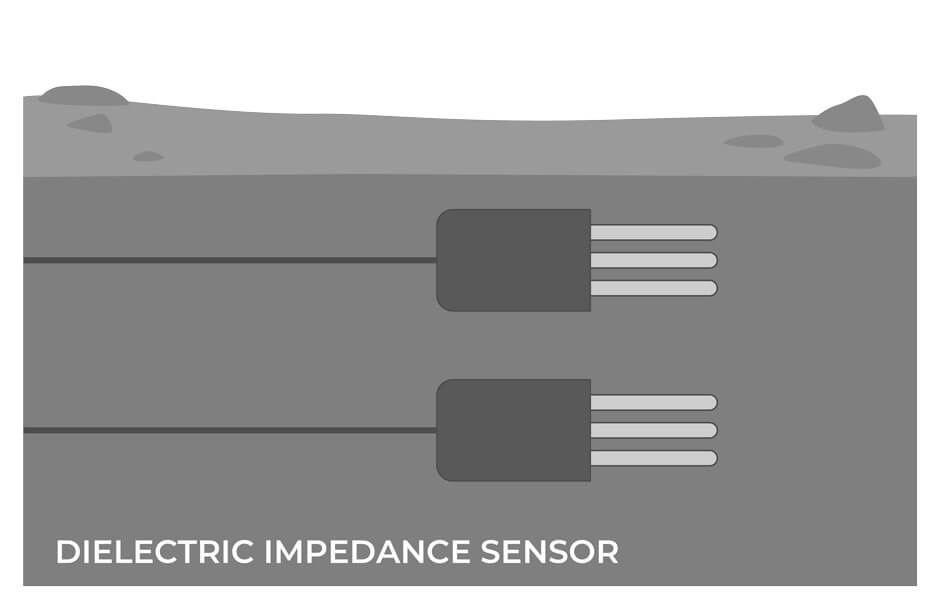
Dielectric impedance sensors relate energy loss between prongs to soil conductivity.
How to Select a Soil Conductivity Sensor?
Selecting a soil conductivity sensor depends on several factors, including the application, environmental conditions and required accuracy. Different sensor technologies offer distinct advantages and limitations.
For general-purpose monitoring in applications like agriculture, capacitance-based sensors provide a cost-effective solution. While these sensors are less precise in separating conductivity and moisture effects, they are sufficient for many applications and can help identify trends in salinity and soil health.
For research applications or situations requiring high accuracy, time-domain reflectometry (TDR) or dielectric impedance sensors are preferable. TDR sensors are well-suited for precise measurements of soil salinity and moisture, as they capture the interplay between soil dielectric properties and salinity levels. Dielectric impedance sensors provide detailed data across many soil types and are ideal for applications where soil EC must be closely monitored alongside other parameters.
Temperature compensation is a critical consideration when selecting any soil conductivity sensor. Conductivity is highly temperature-dependent, and without compensation, readings can vary significantly with environmental changes. Many modern sensors include built-in temperature compensation algorithms to standardize readings to a reference temperature (typically 25°C), ensuring consistent and accurate data.
Durability is another important factor, especially for long-term or outdoor deployments. Sensors exposed to variable moisture levels, high salinity, or extreme temperatures should have waterproof designs and corrosion-resistant materials to ensure reliable performance.
Ultimately, the choice of sensor should align with the specific needs of the application, balancing accuracy, durability, and cost to provide reliable and actionable data.
What to Consider When Preparing a Soil Conductivity Sensor?
One of the most important considerations during soil conductivity sensor preparation is the soil type in which it will measure and the associated sensor calibration.
Many sensors come with default calibrations that cover a range of common soil types. However, it may be possible to select a different calibration for certain soil types such as those containing a relatively high degree of organic matter. Still, other types such as clay-rich soils may require custom calibrations based on comparison with soil samples.
Slurry extracts, water samples, and aqueous solutions can provide supporting data for calibrations and comparisons between sites, though it is important to note that the field soil conditions and corresponding measurement accuracy may vary due to the complexities of the combined soil/water/air matrix. As such, some interpretation and additional analysis of the soil composition may be required.
In extreme cases, soil conductivity can exceed sensor measurement ranges. Very few agricultural applications approach sensor limits, typically starting at around 15 dS/m, but certain situations may require special techniques. Examples include studies of saline soils in arid regions, coastal soils affected by saltwater intrusion, and mines, landfills, or industrial sites with potential contamination from tailings, leaching or chemical spills.
How to Deploy a Soil Conductivity Measurement System?
Deployment of a continuous soil conductivity measurement system depends on the same principles as other types of soil sensor installations like soil moisture sensors, especially since many sensor types combine measurements in a single probe. The installation process includes selecting the appropriate sensor layout, ensuring proper installation, and integrating the sensors with a data logging system.
Refer to deployment of a soil moisture measurement system for more information.
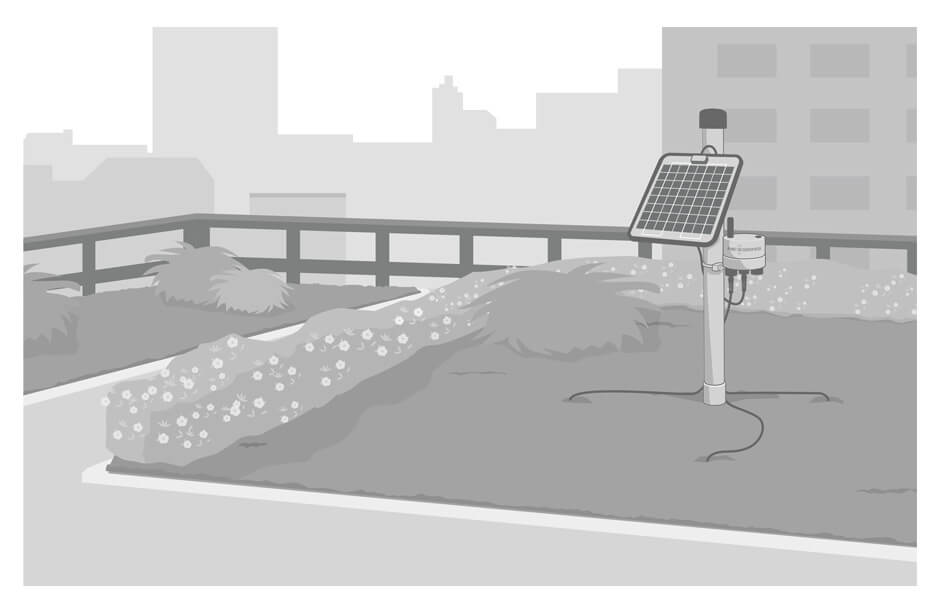
Soil conductivity measurement systems are installed using the same methods as soil moisture measurement systems.
Conclusion
Soil conductivity, or EC, is a vital parameter for understanding soil health, salinity levels, and nutrient availability. Its measurement provides critical insights for a wide range of applications, from optimizing irrigation and fertilization in agriculture to assessing contamination near industrial sites. By accurately monitoring bulk EC, users can identify potential issues early and implement effective strategies to mitigate risks and improve soil management practices.
The selection and deployment of soil conductivity sensors require careful consideration of environmental conditions, application needs, and sensor capabilities. Modern sensors, often integrated with data loggers and telemetry systems, simplify continuous monitoring and provide real-time insights into soil conditions with reliable and actionable data.
By adopting best practices for soil conductivity measurement, researchers, farmers, and environmental managers can make informed decisions that support sustainable land use, protect natural resources, and enhance plant growth.
Additional Resources

