Lancaster County, Pennsylvania, is dominated by agriculture and a developing urban landscape—which result in nutrient-rich runoff that enters into the county’s waterways. Lancaster’s rivers and creeks are part of the larger Susquehanna River Basin and feed into the Chesapeake Bay.
While the Lancaster County Conservation District started monitoring the county’s waterways continuously about 5 years ago, the department is making a major upgrade over the next year as they switch from relying entirely on the internal storage of continuous sondes to real-time data loggers.
Challenge: Telling the Story of Lancaster Through Data
Since the Lancaster County Conservation District started monitoring county waterways, the goal has remained the same, according to Amanda Goldsmith, Watershed Specialist for the Watershed Department.
“Our goal is to tell our own story as we try to restore Lancaster’s streams through restoration and other best management practices,” states Goldsmith.
Because Lancaster’s rivers and streams feed into the Chesapeake Bay, the county has an important role to play in reducing nutrient inputs into the bay. In the Bay Watershed in Pennsylvania, Lancaster alone is tasked with reducing 21% of nitrogen and 23% of phosphorus loads.
In order to achieve the goal, the Lancaster County Conservation District oversees and manages stream restoration projects that improve waterway health via the installation of forested riparian buffers and targeted habitat restoration projects.
The sondes alone helped capture the impacts on water quality but were limited due to instrument failures discovered only when the team traveled to the site to download data.
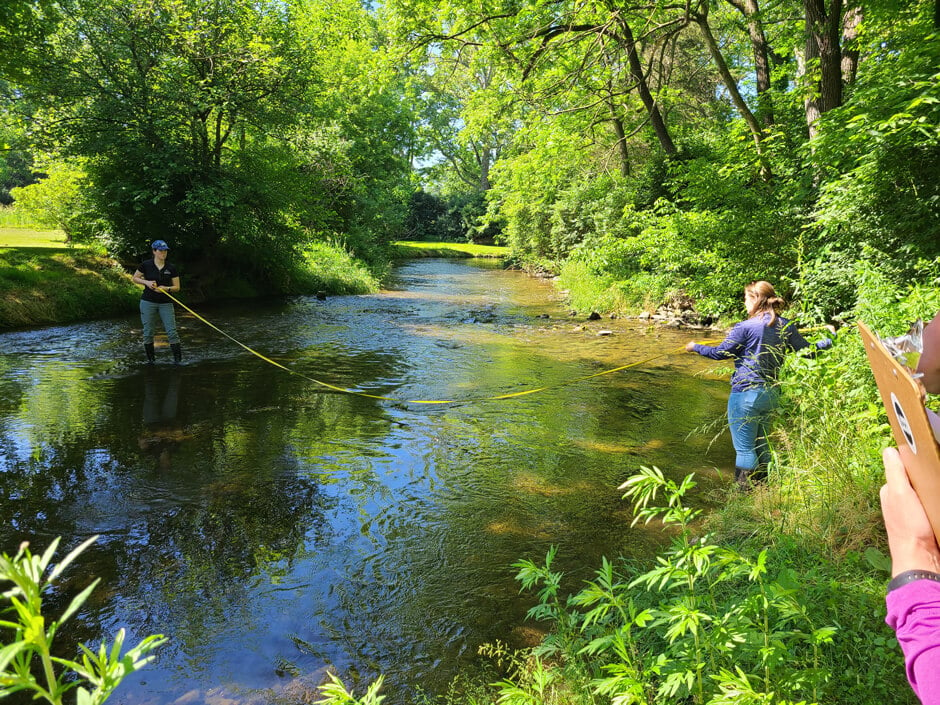
The small team comprised of Goldsmith, Noelle Cudney (Data Coordinator), and Tyler Keefer (Watershed Resource Specialist), were only able to visit sites every seven weeks, resulting in days or weeks of lost data.
Solution: Building Better Data and Updating to Real-Time
This data loss was one of the driving reasons the district decided to purchase 15 NexSens X3 data loggers to update their existing network of YSI EXO2 sondes located throughout Lancaster County.
The sondes continuously measure turbidity, pH, conductivity, temperature, total dissolved solids, and dissolved oxygen, which is logged and transferred to the cloud, where the data is viewable to the team and collaborators through WQData LIVE.
Benefits: Data Accessibility and Quick Response to Data Loss
With the upgrade came the ability to set parameter thresholds and enable alerts when data collection is paused or if water quality conditions exceed allotted limits.
Though only five systems have been upgraded so far, the team has already benefited from the change as they were alerted of a sonde failure due to battery life on the Little Conestoga, allowing the team to respond quickly and minimize interruptions.
The team is also building a historical database akin to others in the region, something that shows the progress Lancaster is making in reducing outputs into the bay.
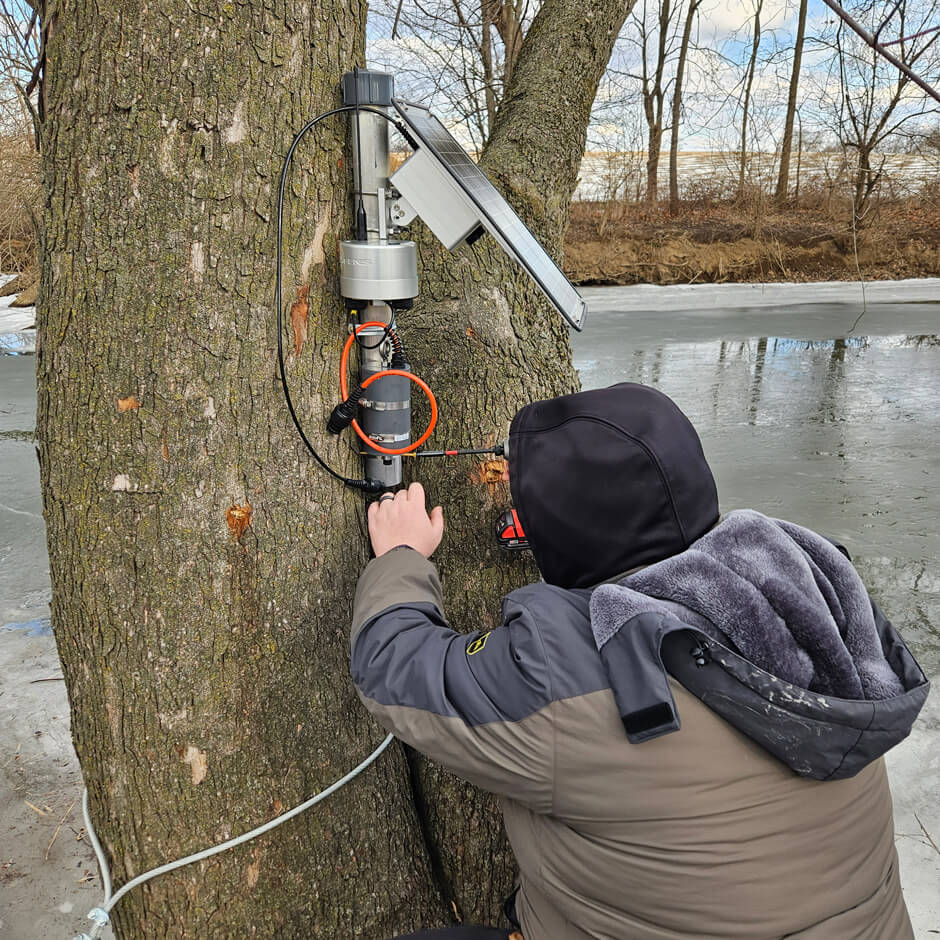 The remaining 10 site updates will depend on agreement from landowners as several of the systems are located on private property and will build on existing and future conservation efforts in the county. However, the district currently plans to deploy five more over the winter into early spring and the remaining five before the end of 2025.
The Bottom Line
Though the county’s monitoring program is relatively new compared to older programs in the region, the program is important and ties back into the bigger picture of improving Lancaster streams.
Goldsmith explains, “We’re not going to see these trends right away, but knowing that my work now, decades later, will finally start to show improvements, is really important.”
She continues, “In Lancaster, we’re starting to see tiny changes. They’re not huge—they’re not dramatic. We have a huge goal to reach… but we’re seeing little changes. We’re seeing fish communities improve, and that’s from decades of work prior. It’s rewarding to know we are contributing to that bigger picture and improving our local and downstream community.”
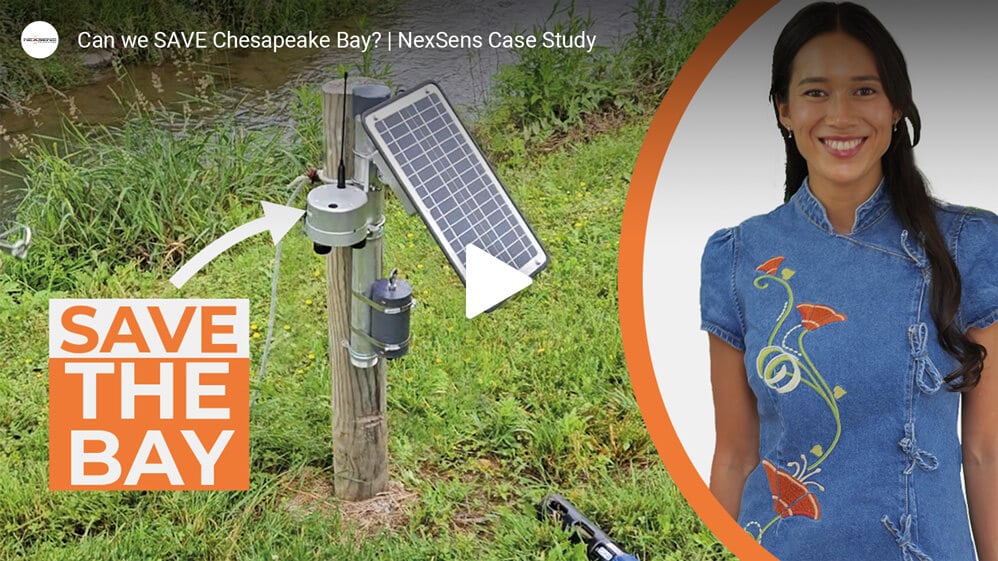
Video Case Study
Equipment
The X3 data logger offers the latest in real-time monitoring technology with wireless communication, a large plug-and-play sensor library, and ultra-low power consumption. 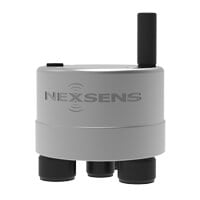
WQData LIVE is a web-based project management service that allows users 24/7 instant access to data collected from remote telemetry systems. 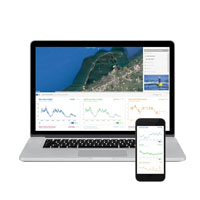
The YSI EXO represents the next generation of water quality instruments from YSI. The EXO2 sonde includes six sensor ports and a central anti-fouling wiper option. 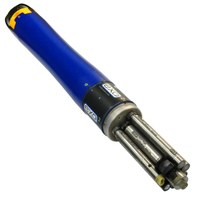
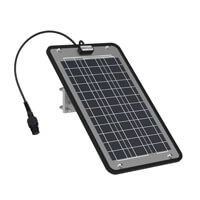
The SP-Series Solar Power Packs feature a solar panel, regulator, and battery housed in a weather-tight enclosure.