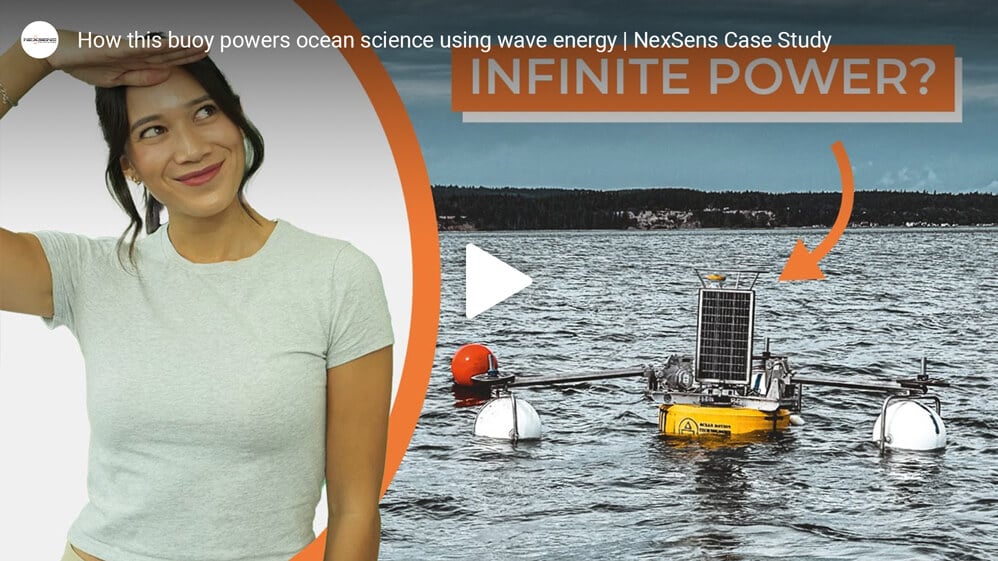
Ocean Motion Technologies’ innovative wave energy conversion (WEC) technology was tested in Puget Sound with a recent deployment of an integrated NexSens CB-1250 data buoy. The wave-powered buoy is pushing traditional power limits, supplementing solar power and increasing overall power generation in low-light conditions, such as poor weather, nighttime, or high-latitude environments.
Challenges: Increasing Offshore Capabilities with Durable Systems
When designing these wave-powered buoys, Ocean Motion is focused on creating a durable and powerful platform capable of being used across various coastal sectors, directly supporting the Powering the Blue Economy initiative and advancing the “Ocean of Things” paradigm.
“Our firm collaborates with industry leaders like Fondriest Environmental, as well as Federal Agencies such as the U.S. Department of Energy, the National Science Foundation, NASA, and the U.S. Navy, advancing technologies essential to achieving the vision of the ‘Ocean of Things,’” states Pan.
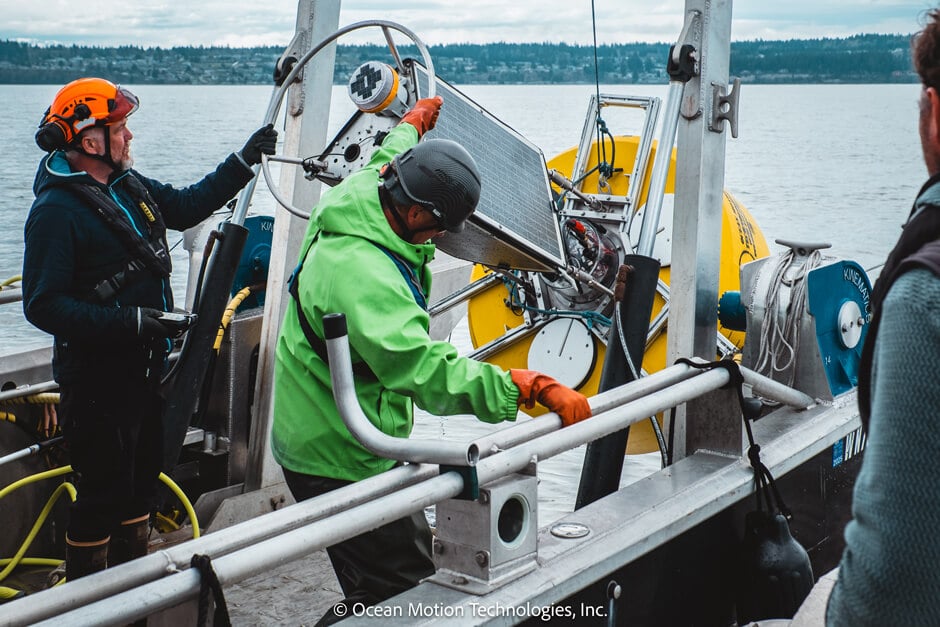 Goals of the Puget Sound deployment specifically included advancing three ongoing projects. First, Ocean Motion was testing Version 2 of their surface wave energy systems, designed to power commercially available data buoys, like the NexSens buoys.
Secondly, the team was evaluating the capabilities of their autonomous underwater vehicle (AUV) docking station, which is integrated and cabled directly to the buoy. Finally, the team was testing a customized data acquisition and telemetry system, which also functions as an advanced wave-sensing device.
When the team first set out to develop their WEC technology and integrate it onto buoys, durability was a primary concern, alongside balancing the cost-effectiveness and practicality of their final products.
Solution: Wave-Powered Buoys Designed for Long-term Deployment
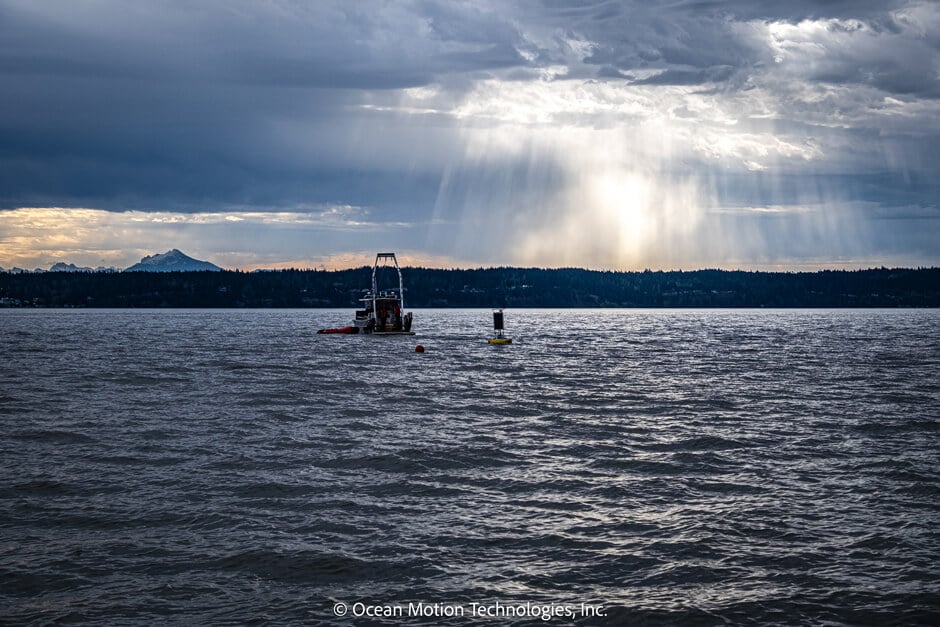 Ocean Motion Technology partnered with Fondriest Environmental and Gravity Marine to conduct rigorous marine monitoring and characterize the operational environment in order to refine the wave-powered systems and pave the way for future commercial activities.
At the core of the system is Ocean Motion’s modular wave energy system integrated directly onto the NexSens CB-1250. The integrated wave sensor captures wave height, direction, and period. Top-side meteorological sensors include an Airmar 200WX-IPX7 WeatherStation, and underwater, a Sea-Bird Scientific HydroCAT CTD collects water quality data.
A Sunfish AUV docking station was also tested during this deployment, enabling reliable subsea docking, battery charging, and high-speed data transfer capabilities. An additional Deep Trekker remotely operated vehicle (ROV) helped capture visuals of underwater conditions while a topside environmental camera recorded surface conditions.
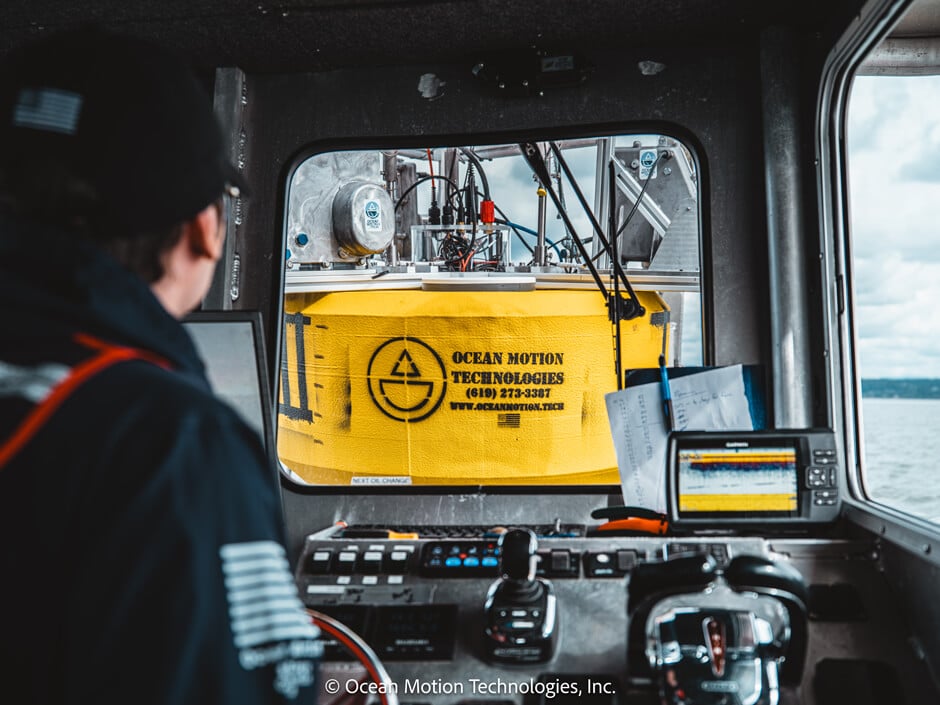 The fully equipped system offers a multifaceted view of the deployment environment, capturing weather, wave, and water conditions.
Benefits: Expanded Capabilities with Wave-Powered Buoys
Supplemental wave energy plays a key role in pushing these systems to their full potential by providing continuous power at all times of the day. Pan explains, “If you can suddenly generate a little more power, say, hundreds of watts, then all of a sudden, you can do remarkable things in the ocean.”
“For example, deploying novel instruments such as in-situ imaging flow cytometers or a large suite of common water quality sensors—used in supporting remote sensing, biological monitoring, and algorithm development—can quickly consume the power produced by these wave modules,” he continues.
Because the systems can enable a larger host of sensors and more power-hungry operations, wave-powered systems have the potential to empower offshore operations ranging from research to defense applications beyond the current state of the art.
 “For defense applications, our enhanced ocean monitoring technologies provide critical intelligence, surveillance, and reconnaissance (ISR) capabilities, strengthening coastal security, and national defense infrastructure,” states Pan.
The Bottom Line
The wave-powered buoys provide such consistent energy that users from all sectors can refine the systems to meet their specific needs. For some users, their primary interest is remote, real-time access to environmental data, as well as the flexibility to monitor current conditions spontaneously.
For others, the priority is generating sufficient power to support large-scale data collection, while continuous remote access is less critical. Both scenarios typically involve power-intensive instrumentation, which makes wave energy solutions particularly valuable for enabling extensive aquatic data collection.
Ultimately, this inherent scalability and broad application potential of wave energy technology underscores its significance within the broader objectives of the Powering the Blue Economy Initiative.
Video Case Study
Equipment
The CB-1250 offers increased flotation and solar charging for heavy or power-hungry sensors while still maintaining a relatively small footprint. 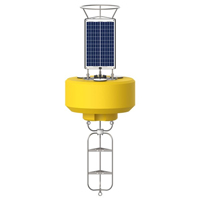
The Airmar 200WX is a compact weather station ideal for moving platforms. The sensor outputs apparent and true wind, barometric pressure, air temperature, GPS location, and more. 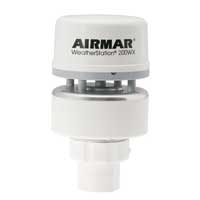
The Sea-Bird Scientific HydroCAT CTD is ideally suited for extended deployments in remote, biologically rich environments. 
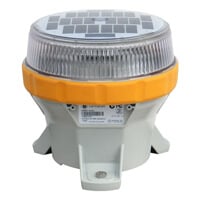
NexSens M650H solar marine lights are designed for mounting to the larger CB-Series data buoys per USCG requirements.