
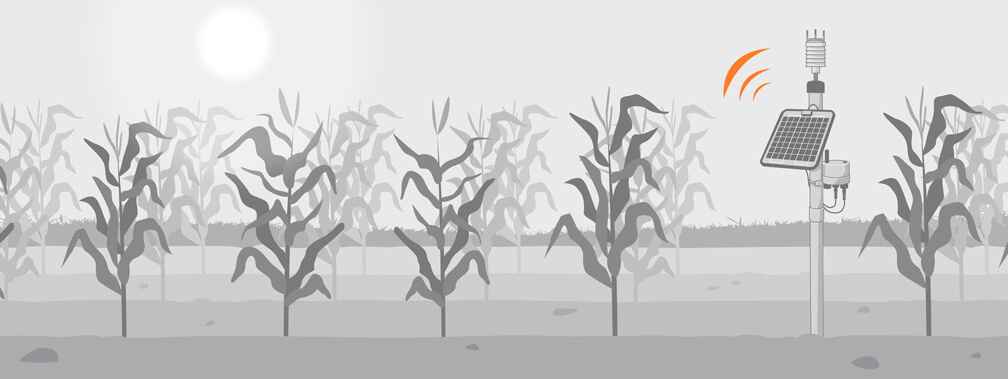
Solar radiation is the electromagnetic energy from the sun that reaches the Earth. It is a fundamental component of the Earth’s climate system and is critical for various environmental and meteorological studies. The amount of solar radiation reaching the Earth’s surface depends on various factors such as the angle of the sun, atmospheric conditions, and geographic location.
Solar irradiance refers to the power per unit area received from the sun’s radiation and is typically measured in watts per square meter (W/m²). It represents the radiant flux density over a given area at a specific moment. Insolation adds a time component to express the amount of solar radiation energy on a surface in a given period of time. Common units are Watt hours per square meter (Wh/m²) or kilowatt hours per square meter (kWh/m²).
Why Measure Solar Radiation?
Solar radiation encompasses a range of wavelengths of light emitted, which fall in the ultraviolet (UV), visible, and infrared (IR) range of the light spectrum from about 150 to 4000 nm. This radiation produces light and warmth, provides the energy that drives photosynthesis, and is essential for life on Earth. However, the high-energy radiation in the UV spectrum can also have damaging effects on humans, plants, and animals:
- Infrared: Wavelength > ~750 nm; contributes to warming Earth’s surface.
- Visible: Wavelength 380-750 nm; provides light and enables photosynthesis.
- Ultraviolet: Wavelength < ~380 nm; can affect DNA and harm living organisms.
Depending on how thresholds are defined, infrared light accounts for about 49-53% of all solar radiation, visible light for about 42-43%, and ultraviolet light for about 4-9%.

Solar radiation falls within the ultraviolet, visible, and infrared portion of the electromagnetic spectrum from about 150 to 4000 nm.
The heating effect of infrared radiation (IR) plays a crucial role in regulating the Earth’s climate and weather patterns, as it is both reflected and absorbed by water and carbon dioxide molecules. IR is also essential for various biological processes, such as thermoregulation in animals. However, excessive exposure can lead to heat stress.
Visible radiation, or visible light, is responsible for the colors we perceive and is crucial for various biological processes, particularly photosynthesis. A subset of visible radiation, known as Photosynthetically Active Radiation (PAR), specifically refers to wavelengths from 400 to 700 nm.
PAR is the spectrum of light that plants use for photosynthesis, converting light energy into chemical energy to fuel their growth. This process is fundamental to the production of oxygen and the food supply for virtually all life on Earth.
UV radiation is divided into three types: UV-A, UV-B, and UV-C.
- UV-C, the most energetic and potentially harmful, is almost entirely absorbed by the Earth’s atmosphere, and little to none reaches the surface.
- UV-B is largely absorbed by atmospheric ozone, but the portion that passes through can cause sunburns, skin cancer, and DNA damage from overexposure.
- UV-A, which penetrates the atmosphere more freely, contributes to skin aging and can impair photosynthesis in plants, though is also crucial for producing vitamin D in humans and plays a role in sterilizing the environment by killing bacteria and other microorganisms.
How Is Solar Radiation Measured?
Solar radiation is measured with radiometers, which are instruments used to measure the intensity of electromagnetic radiation, including light. There are several different types of radiometers, each specialized for different aspects of solar radiation:
- Pyranometers measure global short-wave solar radiation (Global Radiation), including both direct and diffuse sunlight. They are equipped with a thermopile sensor that generates a voltage proportional to the incident solar radiation.

Pyranometers measure across the entire spectrum of solar radiation.
- Pyrheliometers measure Direct Solar Radiation by focusing sunlight onto a thermopile sensor. They require precise alignment with the sun and are typically used in conjunction with a solar tracker.

Pyrheliometers focus sunlight to measure direct solar radiation only, eliminating the effects of diffuse radiation.
- Pyrgeometers measure long-wave infrared radiation, which primarily comes from short-wave solar radiation that is absorbed by the Earth and re-emitted as long-wave (3000 nm-50,000 nm). They use a thermopile sensor that filters out short-wave radiation.

Pyrgeometers measure long-wave radiation in the infrared spectrum.
Combinations of pyranometers and pyrgeometers can be used to measure advanced meteorological parameters related to radiation:
- Diffuse Sky Radiation is a measure of indirect solar radiation in the atmosphere taken by a pyranometer shielded from direct sunlight using a shading device with solar tracker.

A pyranometer shielded from direct sunlight can measure diffuse sky radiation.
- Atmospheric Radiation refers to all short-wave and long-wave radiation in the atmosphere measured using an upward-facing pyranometer and pyrgeometer.
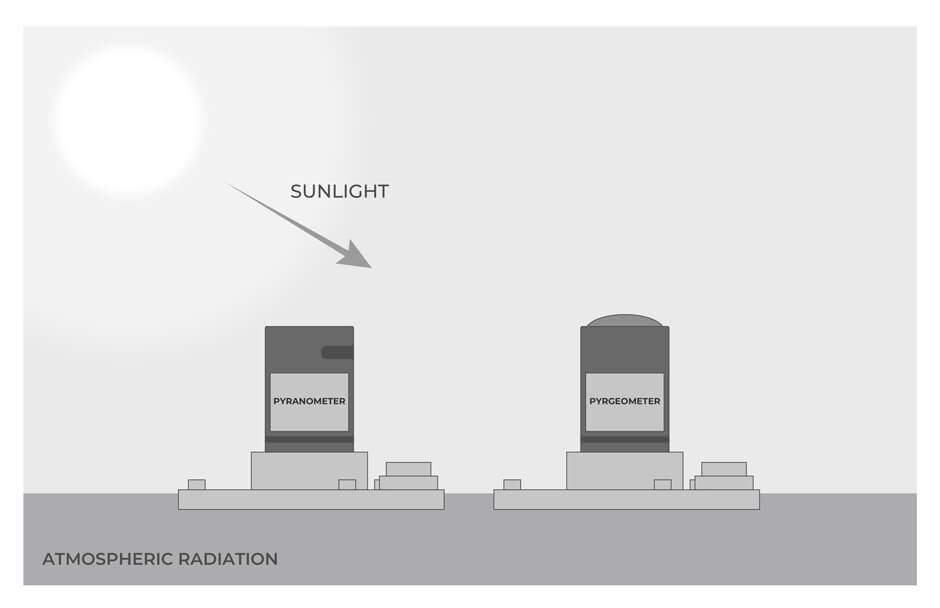
Upward-facing pyrgeometers and pyranometers measure incoming atmospheric radiation.
- Ground Surface Emission is the amount of radiation reflected or emitted by the Earth’s surface measured using a downward-facing pyranometer and pyrgeometer shielded from horizontal glare.

Downward-facing pyrgeometers and pyranometers measure radiation emitted by the Earth.
- Radiation Balance is the net measurement of all incoming and outgoing radiation, which is measured using an upward-facing and downward-facing pyranometer-pyrgeometer pair. This arrangement is also commonly referred to as a Net Radiometer.

Net radiometers measure the balance of incoming and outgoing radiation.
Within the realm of global solar radiation, there are also specialized sensor types for measurement of specific radiation ranges:
- Quantum sensors use a silicon photodiode to specifically measure PAR. They are commonly used in both terrestrial and underwater configurations.

Quantum sensor designs measure both atmospheric and underwater PAR.
- Photometric sensors measure illuminance within the visible light spectrum in lux with the sensitivity of a typical human eye using a silicon photodiode with precision filter. They are commonly used for indoor lighting studies.

Photometric sensors measure light visible to the human eye.
How to Select a Solar Radiation Sensor?
When selecting a solar radiation sensor, the specific application and corresponding wavelength range of interest are the driving factors for sensor selection.
Pyranometers are the go-to instrument for general global radiation measurements. If direct solar radiation is the main interest, a pyrheliometer would be more suitable. For measurements of the Earth’s long-wave emissions, a pyrgeometer is required.
Advanced meteorological studies may call for a combination of instruments for measurement of specialized parameters like ground surface emission or radiation balance using a net radiometer device.
For applications involving plant growth, a quantum sensor should be selected due to its focus on PAR. Or if measurement of light visible to the human eye is the primary objective, then a photometric sensor is the correct instrument.
Regardless of the instrument type, other factors to consider include the accuracy, response time, temperature dependence, and spectral sensitivity of the sensor. Additionally, environmental conditions, such as temperature ranges, humidity, and maintenance requirements, should be assessed to ensure the selected sensor will function effectively in the specific monitoring environment.
Lastly, cosine response is an important feature to look for in radiation sensors. This refers to a sensor’s ability to accurately measure the angle of incoming radiation and is also referred to as cosine correction or directional response. Incoming sunlight rarely arrives at a perfect perpendicular angle to the sensor, so the sensor must accurately account for the varying angle of incidence.
What to Consider When Preparing a Solar Radiation Sensor?
Solar radiation sensors require an unobstructed path to the sky for accurate measurement. Proper sensor placement is critical for acquiring reliable data. Obstructions like trees, buildings, or other objects that could cast shadows on the sensor must be avoided.
Regular calibration and maintenance are also important to ensure accurate readings. For many sensors, cleaning the outer glass dome or lens can improve the accuracy of solar radiation measurements, particularly in dusty or humid environments.
How to Deploy a Solar Radiation Measurement System?
The same principles apply to deployment of solar radiation sensors as with other meteorological parameters. Site selection and proper mounting are paramount, regardless of whether the sensor is a standalone unit or a part of a multi-parameter instrument.
Sensors must be placed clear of any obstructions like trees or buildings that may cause error due to shading. For mounting on buildings, masts, or other structures, installation guidelines will typically suggest a minimum or optimal mounting height.
Leveling the sensor during installation ensures that it can achieve its specified measurement accuracy. Accessibility for periodic cleaning is also a fundamental aspect of long-term maintenance, especially in areas prone to high humidity or dust collection.

Solar radiation sensors must be mounted free from obstruction and shading that could introduce measurement error.
In studies of PAR in aquatic environments, sensors can be placed both on top of the buoy tower as well as underwater. A typical configuration might have one terrestrial, tower-mounted PAR sensor with one or more underwater sensors on a mounting arm that removes them from the shading area of the buoy. These may be upward or downward-looking, or both. A two-point mooring system can also help prevent buoy rotation so as to keep the sensors free from shading at all times.
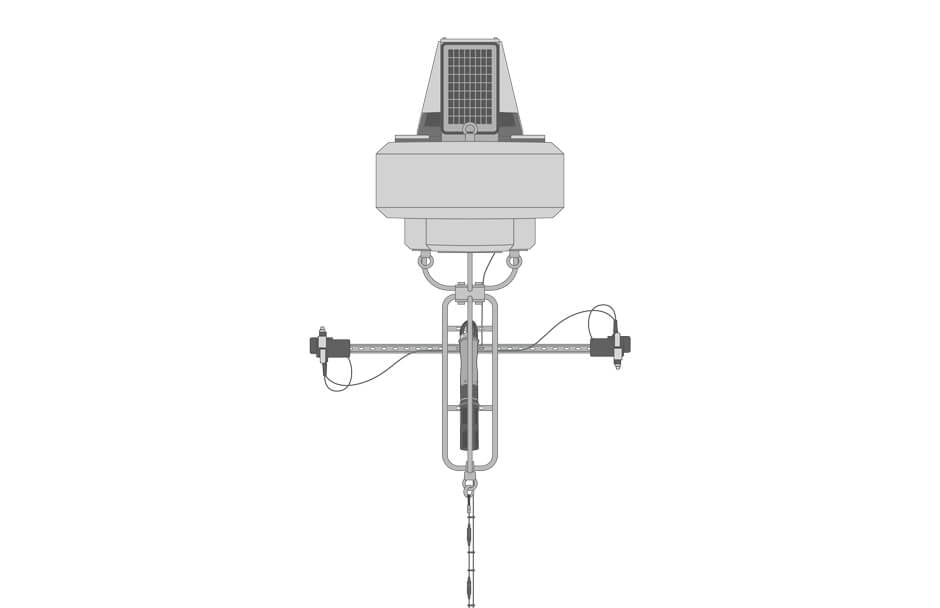
Buoy-based underwater PAR sensors should be mounted to minimize shading from the buoy platform.
Conclusion
Solar radiation measurement is essential for a wide range of environmental and meteorological applications, from understanding Earth’s energy balance to studying photosynthesis and solar energy production.
Different sensor types are available for measurement of global radiation, infrared radiation, photosynthetically active radiation, and visible light. They may also be combined for the determination of more advanced parameters related to radiation.
With proper installation and maintenance including periodic calibration, solar radiation measurement systems can provide years of quality data and help in understanding how energy from the sun impacts our planet.
Additional Resources

