

As outlined in the chapter on water temperature, temperature is a physical property indicating relative hotness or coldness. In the context of meteorology, it is the measure of the thermal energy in the atmosphere that comes from molecular vibrations of air, which primarily consists of nitrogen, oxygen, and argon molecules, as well as trace amounts of other gases. Air temperature is the most fundamental weather measurement that influences most other weather phenomena either directly or indirectly.
The Fahrenheit scale with units of degrees Fahrenheit (°F) and Celsius scale with units of degrees Celsius (°C) are most commonly used to express temperatures, depending on region. In scientific applications, the Celsius scale is favored.
Why Measure Air Temperature?
Air temperature is perhaps more relatable than any other environmental parameter to humans. The daily weather forecast centers around expected temperature ranges that tell us what to expect when we go outside and how we should dress to remain comfortable.
However, the significance of temperature goes much deeper than the daily forecast. Temperature directly impacts global weather patterns and plays a pivotal role in determining climate zones and seasonal variations. This impacts everything from agriculture for food production to energy consumption for heating and cooling.
The behavior of materials and structures is influenced by temperature, as does the rate of chemical reactions in many industrial processes. This makes temperature a key factor in diverse fields such as construction, manufacturing, and energy management.
Besides direct impacts on the environment and human activities, air temperature affects other meteorological measurements and phenomena, including:
- Humidity: The capacity of air to hold moisture increases with temperature. Higher temperatures can lead to higher humidity levels, which can influence weather patterns and human comfort.
- Dew point: The temperature at which air becomes saturated with moisture and water vapor begins to condense into dew. Dew point is closely related to air temperature and is used to predict weather conditions such as fog and frost.
- Atmospheric pressure: Temperature variations can cause changes in atmospheric pressure, leading to the formation of high and low-pressure systems that drive weather patterns and storm development.
- Wind: Temperature-driven pressure gradients can influence both global and local wind patterns. Warm air tends to rise and create areas of low pressure, while cooler air sinks and creates high-pressure areas.
- Wind chill: Wind chill is a measure of how cold it feels when wind is factored into the air temperature. It is a critical factor in assessing the risk of frostbite and hypothermia in cold weather.
- Heat Index: The heat index combines air temperature and humidity to estimate how hot it feels. It is used to assess the risk of heat-related illnesses such as heat stroke and heat exhaustion.
- Evaporation and transpiration: Temperature influences the rate of evaporation from water bodies and transpiration from plants. These processes are essential components of the water cycle and have significant impacts on agriculture and water resource management.
- Precipitation: Air temperature plays a crucial role in the formation and type of precipitation. Warmer air can hold more moisture, which can lead to increased humidity and potential precipitation. Additionally, temperature determines whether precipitation falls as rain, snow, sleet, or freezing rain.
- Soil temperature: Air temperature can affect soil temperature, which in turn influences plant growth, seed germination, and microbial activity in the soil.
While the dynamics of weather patterns are highly complex and not dependent on air temperature alone, there is a clear influence in most meteorological observations.
How Is Air Temperature Measured?
Temperature is typically measured with a thermistor or a resistance temperature detector (RTD).
Thermistors are constructed of a semiconductor whose resistance changes predictably and consistently with fluctuations in temperature. In meteorological applications, NTC (negative temperature coefficient) thermistors are most common. These are characterized by decreasing resistance as the temperature increases and are useful for their quick response time and sensitivity to small changes.
RTDs also measure using resistance but have a linear relationship where resistance increases with temperature. RTDs are usually made from pure metals, with platinum being a common choice for its high accuracy and stability.
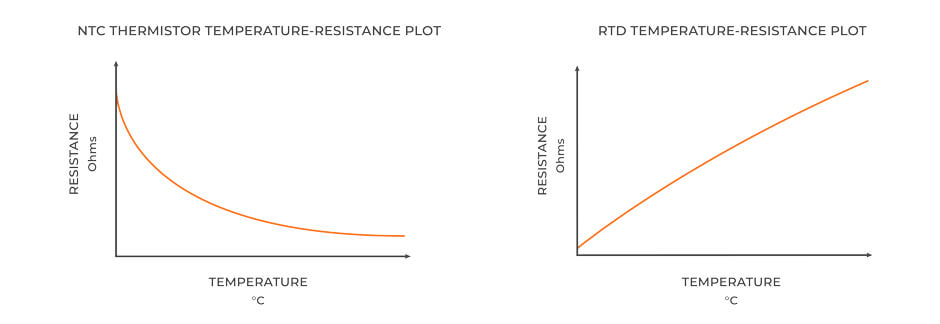
NTC thermistors are characterized by decreasing resistance as the temperature increases, while RTD resistance increases with temperature.
How to Select an Air Temperature Sensor?
In air temperature measurement, the most important considerations for sensor selection include accuracy, traceability, power consumption, and response time.
Many weather stations follow standards such as those set forth by the National Weather Service (NWS) in the US, the European Meteorological Services Network (EUMETNET) in Europe, or the World Meteorological Organization (WMO). Such standards will normally specify required accuracy and resolution, traceability to a recognized standard, acceptable long-term drift, and calibration if applicable.
Temperature sensors are available in standalone configurations or integrated into multi-parameter instruments with other meteorological sensors. Temperature is frequently combined with relative humidity due to the relation of these parameters.
For remote weather stations operating with an autonomous power supply, the sensor’s power consumption should be evaluated against the available capacity. Sensor response time becomes critical in situations where the sensor is turned off between measurements to conserve power.
What to Consider When Preparing an Air Temperature Sensor?
Since direct solar radiation can introduce measurement error, air temperature sensors are often installed inside of a radiation shield. These shade the sensor measurement element but allow ample air flow to equilibrate with the atmosphere.
In certain situations, aspirated radiation shields are used to provide continuous ambient air flow to the measurement element for error reduction. An aspirated radiation shield may be preferred in environments that experience intense solar radiation, low wind speeds, high humidity or precipitation, or urban heat island effect, provided that a sufficient power supply is available.
How to Deploy an Air Temperature Measurement System?
In addition to sensor specifications, weather station standards often specify sensor mounting requirements. For example, an air temperature sensor may be required to be mounted on a mast of certain height above the ground and with a certain distance from any obstructions like buildings or trees.

Air temperature sensors are frequently mounted on masts or towers to meet standard requirements and ensure representative measurements.
Some applications call for air temperature (and frequently relative humidity) measurement at multiple heights above the ground for redundancy or to observe gradients between air layers.
Temperature measurement is also common in buoy-based applications. Similar to land-based systems, sensors are frequently integrated into multi-parameter instruments and should be placed at a representative height for measurement accuracy. The sensor placement should be chosen to minimize potential interference from splashing or other obstructions.
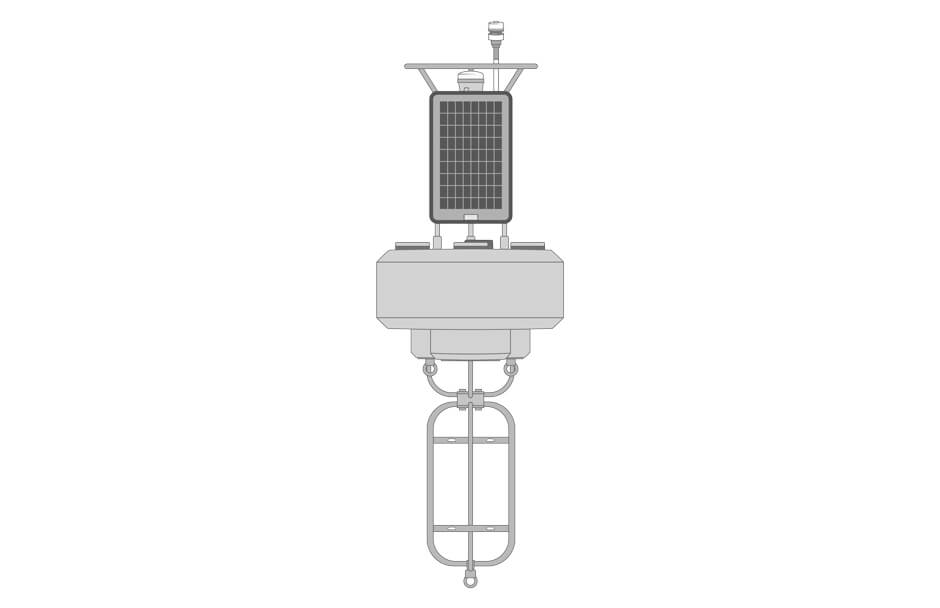
Buoy-based air temperature sensors should be shielded from splashing and other interference.
Conclusion
Air temperature measurement is a fundamental aspect of meteorology and environmental monitoring, impacting a wide range of human activities and natural processes.
Accurate air temperature data is essential for weather forecasting, climate studies, agricultural planning, and energy management. It influences other critical meteorological parameters such as humidity, dew point, atmospheric pressure, wind chill, heat index, wind patterns, and precipitation types, making it a cornerstone of comprehensive weather observation systems.
By understanding and implementing best practices in air temperature measurement, meteorologists and environmental scientists can obtain high-quality data that supports accurate weather forecasting, climate research, and effective environmental management.
Additional Resources

