

Soil moisture is the amount of water present in the pore spaces between soil particles. It is influenced by several factors, including rainfall, runoff, root absorption, and evaporation. Soil composition, texture, structure, and organic matter content also affect a soil’s capacity to absorb and release water, with finer soils like clay retaining water more effectively than sandy soils.
In practical terms, for some applications, such as those related to plant growth or watershed management, soil moisture is described in terms such as saturation, field capacity, and wilting point depending on the amount of water present:
- Saturation: All soil pores are completely filled, and gravitational (excess) water is lost to runoff or drainage. No air is present for plant roots to breathe.
- Field Capacity: The amount of water remaining after all excess is drained, determined by the amount of water the soil pores can hold against gravity by soil tension. Some air is present in larger pores.
- Available Water: Between field capacity and the wilting point, soil pores maintain some water available to plants. If no water inputs arrive, moisture is gradually lost to plant uptake and evaporation.
- Wilting Point: Some moisture is still present in the soil, but no water is available to plants because the roots cannot overcome the tension binding the water molecules to the soil pores.

One way soil moisture can be described is by the amount of water in the soil pore spaces as it relates to availability to plants.
In scientific measurement terms, soil moisture is typically expressed as volumetric water content (VWC), representing the volume of water as a percentage of the total soil volume. For instance, a reading of 20% VWC means that water makes up 20% of the soil’s volume.

Volumetric Water Content (VWC) expresses the soil moisture as the percentage of water by volume in a soil sample.
Alternatively, soil moisture can be given as gravimetric water content (GWC), which is the ratio of the mass of water in a soil sample to the dry mass of the soil. Like VWC, it is usually expressed as a percentage. However, GWC requires laboratory analysis to weigh and dry the sample for accurate calculation. VWC is, therefore, more common for remote, in situ monitoring applications.
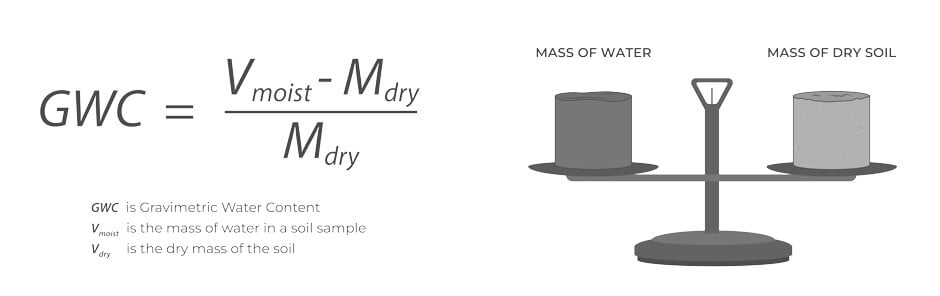
Gravimetric Water Content (GWC) expresses water content by mass.
Finally, soil moisture can be measured as soil water tension, often represented in centibars (cb) or kilopascals (kPa), which indicates the force required to extract water from the soil pores. Higher tension values imply drier conditions and lower water availability for plants, making soil water tension especially useful for irrigation planning and plant care.
Why Measure Soil Moisture?
Generally, soil moisture is a balance between water inputs—such as precipitation and irrigation—and outputs, including plant uptake, evaporation, and runoff. Understanding this balance is essential for a range of applications including:
- Agriculture: Monitoring soil moisture supports efficient water use and planning and optimization of irrigation cycles, helping to maximize crop yields while conserving water resources and minimizing nutrient runoff.
- Construction: Soil stability is critical for building foundations, earthworks, and roads. Moisture levels influence compaction, settling, and the overall suitability of soils in many construction projects.
- Flood Prediction and Warning: Soil moisture data helps in understanding soil water retention and runoff conditions, thereby supporting flood forecasting and watershed management.
- Water Resource Management: Groundwater wellfields used for drinking water supply benefit from soil moisture data to monitor recharge rates and potential movement of contaminants.
- Turf Management: For golf courses, sports fields, and lawns, soil moisture monitoring helps ensure that water availability matches turf needs without overwatering, which can lead to shallow roots or fungal growth.
- Green Roof Management: For green roofs, soil moisture monitoring ensures that plants have adequate water while preventing excess water accumulation that can strain building structures.
- Environmental Studies: Soil moisture serves as a key indicator of ecosystem health, particularly in sensitive habitats like wetlands and arid regions, as it helps researchers understand how moisture patterns impact local flora and fauna.
How Is Soil Moisture Measured?
Sensors for soil moisture measurement generally provide either VWC or soil water tension readings, depending on the application.
Several methods exist for VWC measurement. For remote environmental monitoring applications, the most common techniques are capacitive, time-domain reflectometry (TDR), frequency-domain reflectometry (FDR), and dielectric impedance.
What these methods all have in common is that they estimate soil moisture indirectly by measuring the soil’s dielectric permittivity, which can be simply defined as the ability of the soil to store a charge in response to an applied electric field. This property varies with moisture content, as water has a high dielectric constant compared to soil minerals and air. The dielectric constant is a value comparing permittivity of a material to a vacuum and is also known as relative permittivity.
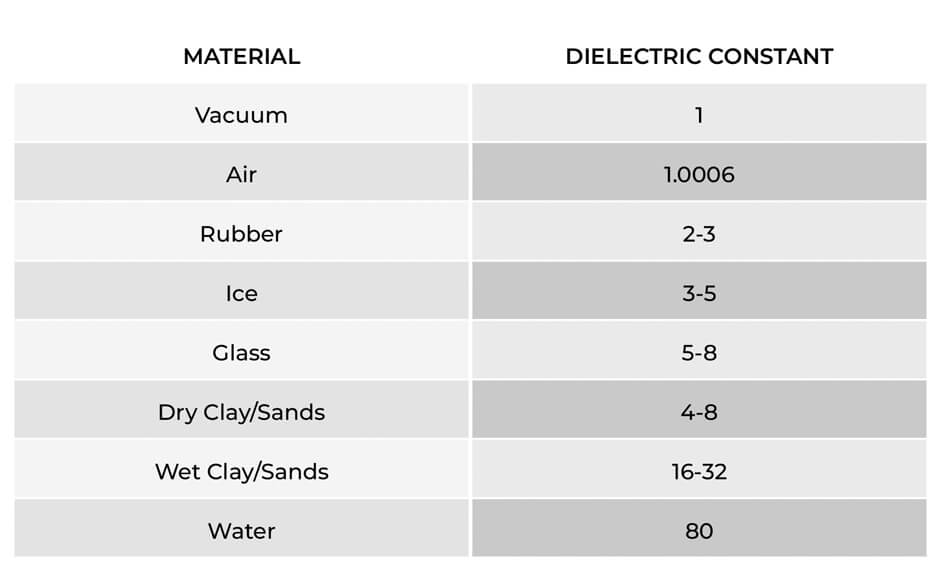
Typical relative permittivity of various materials and soils.
Capacitive sensors use two conductive plates or prongs inserted into the soil, with the soil acting as the dielectric (insulating) material. They apply a small alternating voltage between the conductors and measure the resulting capacitance (the ability of a system to store electrical energy in an electric field), which increases with soil moisture content due to the relatively high dielectric permittivity of wet soil compared to dry soil. Through this measurement, capacitive sensors provide an estimate of the soil’s VWC.
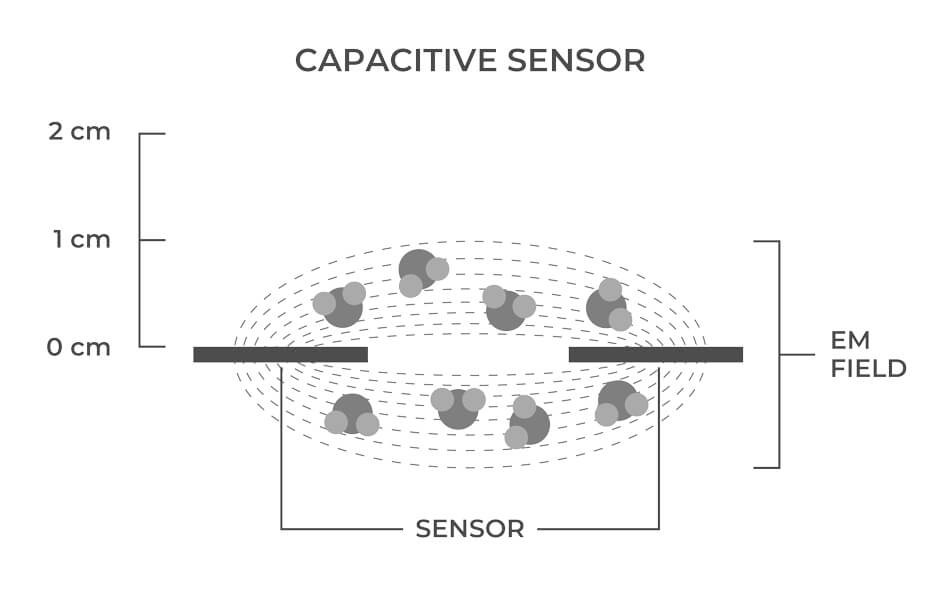
Capacitive sensors create an electric field between two conductors to measure soil moisture.
TDR sensors measure soil moisture by sending electromagnetic pulses into the soil through metal probes or wires and measuring the time it takes for the pulses to reflect back. When a pulse encounters the soil, its travel time is affected by the soil’s dielectric permittivity, as the presence of water slows it down. By analyzing the speed of the pulses against a calibration, TDR sensors determine the soil’s VWC.

TDR sensors measure the travel time of electromagnetic pulses through rods inserted into the soil.
FDR sensors are a capacitive technology as they operate by applying an oscillating electric field of a specific frequency to the soil, but they are tuned to measure changes in the soil’s resonant frequency. The frequency shift is directly influenced by the soil’s dielectric permittivity. By measuring the shift and comparing with a soil-specific calibration, FDR sensors determine the soil’s VWC.

FDR sensors measure the resonant frequency from an electric field applied to rods inserted into the soil.
Dielectric impedance sensors apply a high-frequency electromagnetic wave through conductive prongs inserted into the soil, measuring the soil’s impedance (resistance to alternating current), which decreases as the moisture level of the soil increases. This technique captures both energy storage and losses. Combined with advanced processing, this allows the sensor to provide soil moisture data along with additional parameters like soil temperature, salinity, bulk conductivity, and real permittivity.
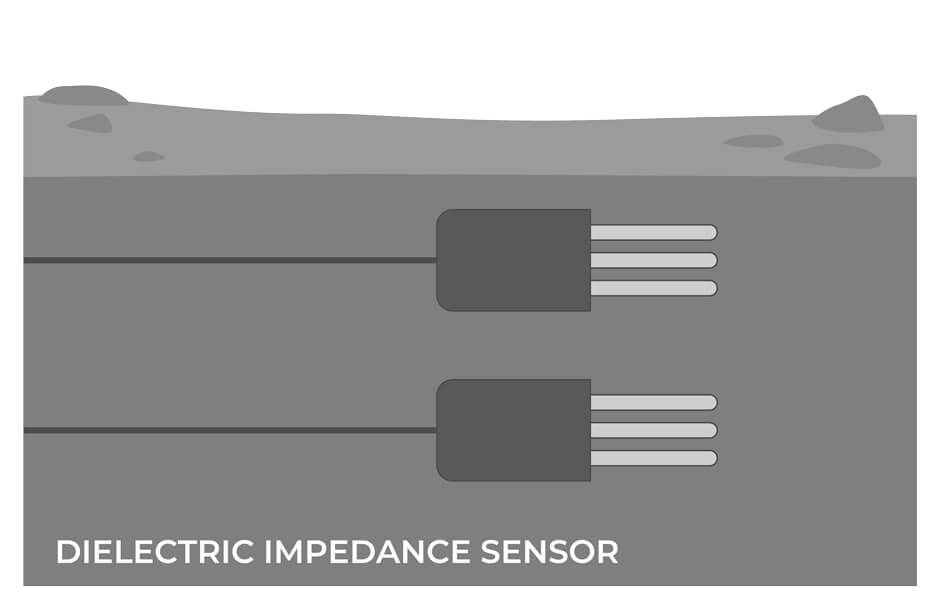
Dielectric impedance sensors measure by sending electromagnetic waves through prongs inserted into the soil.
Soil water tension, which reflects the effort needed to extract water from the soil, is measured by devices called tensiometers. These work by inserting a water-filled tube with a porous tip into the soil. When the soil is drier than the water in the tensiometer, water is drawn out, creating tension within the device. This tension force is measured by a pressure gauge.

Tensiometers measure the tension force created by water drawn out of a sealed tube by the soil.
How to Select a Soil Moisture Sensor?
Soil type and environmental conditions may influence sensor selection because certain sensors perform better with specific soil textures. Additionally, soil temperature and conductivity may cause interference with some sensor types. For example, the accuracy of many sensors, capacitance-based in particular, may be less accurate in high-salinity soils.
In general, TDR and dielectric impedance sensors offer good accuracy and applicability to many common soil types without special calibration, making them ideal for research and other applications requiring a high degree of accuracy. However, TDR sensors involve relatively complex installations due to the advanced electronics required to generate and process high-frequency signals.
Capacitive sensors offer a relatively simple and cost-effective alternative. Though potentially less accurate depending on soil type and calibration, they are often sufficient for general-purpose applications such as agriculture.
FDR sensors are a capacitance-based technology that are generally more accurate and less susceptible to interference than basic capacitance sensors. As such, they strike a balance between accuracy, complexity, and cost for some applications.
Many VWC sensor types have pronged configurations or flat plates that are pressed into a single point or layer of the soil. In some applications like drainage studies and irrigation, it may be beneficial to measure soil moisture at multiple depths in the soil column.
For such cases, some capacitance-based sensors (including FDR) offer vertical probe configurations with sensors placed at multiple depths along the probe. This presents a convenient alternative to traditional probes that require larger excavations (and more soil disturbance) to place probes at depth.
TDR sensors may also be arranged into a profiling probe by coiling wires through which electrical pulses are transmitted in a helical configuration around a probe that is inserted into the soil.
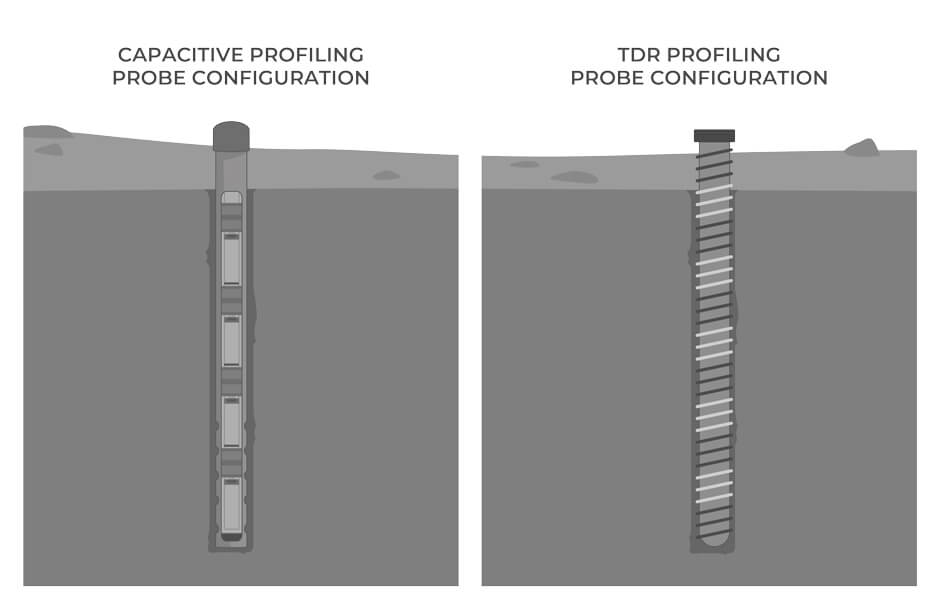
Capacitive (left) and TDR (right) profiling probe configurations.
Lastly, sensors for long-term, outdoor use should be durable and waterproof to withstand changing environmental conditions, especially in remote monitoring setups where maintenance is infrequent. Most in situ soil sensors are ruggedized for long-term use buried in the soil, but some may offer a particularly high IP rating or relatively long warranty period.

Comparison of various sensor types.
What to Consider When Preparing a Soil Moisture Sensor?
Proper preparation and installation of soil moisture sensors is essential to ensure reliable and accurate data collection. Key considerations include calibration and selection of the installation location and depth.
Many sensors come factory-calibrated, but adjustments are often needed for the specific soil type or moisture range, depending on the sensor type. Calibration ensures the sensor’s readings accurately reflect the local soil moisture conditions.
The sensor placement should represent the area of interest, such as within the root zone for agricultural applications and in a field location that gives an accurate indication of the general moisture conditions. Avoid placing sensors in areas with potential disturbances, such as high foot traffic, animal paths, or near sources of localized water pooling.
Multiple sensors placed at various locations may help to provide a more comprehensive picture of moisture conditions and verify sensor readings or indicate spatial variations, particularly if the site contains multiple irrigation zones or varied soil types.
How to Deploy a Soil Moisture Measurement System?
Deploying a soil moisture measurement system involves choosing the right sensor layout, carefully placing the sensors, and integrating them with a data logging system.
In addition to considering the soil conditions for sensor placement, consider how the cables will be routed to the data logging system. Cabling should ideally minimize the total distance and disturbance of the site. Buried cables should also be protected by rugged conduit and placed at a depth that will avoid damage during any land management procedures such as plowing, tilling, or aerating.
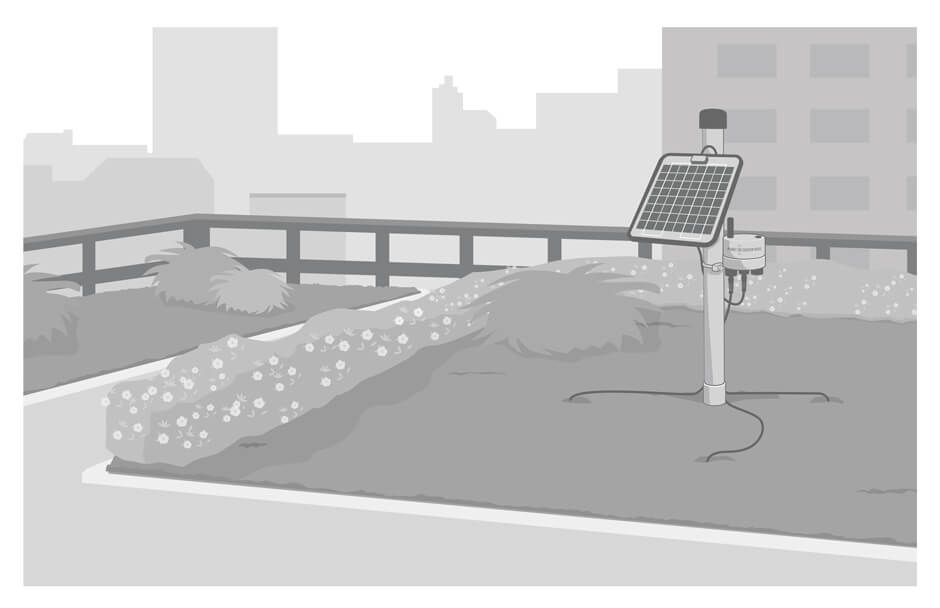
A typical soil moisture measurement system consists of several sensors at different depths or locations connected to a central data logger.
Sensor installation also requires some degree of soil disturbance, either by excavating to the desired depth for pronged sensors or drilling a vertical hole for profiling instruments. Particularly for excavations, the soil should be disturbed as little as possible to avoid changing the soil texture and drainage conditions in a way that can lead to measurement inaccuracy.
When inserting the probes, use caution to avoid creating air gaps around the sensor prongs or profiling device, as this can lead to measurement error and create a preferential drainage path for water. Solid contact with the soil is essential for accurate measurement. In some cases, a slurry consisting of material from the soil to be measured can be created to help ensure proper contact. The slurry must be allowed time to assimilate with the surrounding soil before readings can be considered valid.

Profiling soil moisture probes are inserted vertically into the soil column with sensors placed at critical depths.
Use compatible data loggers to record soil moisture readings. Many modern data loggers allow remote access via telemetry and have self-sufficient power systems (battery or battery with solar panel), making it easier to monitor moisture levels continuously. Accompanying cloud-based software with tools for visualizing moisture levels and alerting to changes can be particularly useful for irrigation planning or environmental assessment.
Set an appropriate sampling frequency based on the application needs. For agriculture, hourly measurements or a few times per day may be sufficient, while research may require more frequent data points. Connecting additional sensor types, such as a rain gauge or multi-parameter weather station, may also provide a more comprehensive dataset, including useful information on water inputs from precipitation.
Conclusion
Soil moisture measurement is a valuable practice across various fields, providing essential insights into water management, plant health, and ecosystem stability. By selecting the appropriate sensors, following proper installation techniques, and maintaining a consistent data collection routine, users can obtain reliable soil moisture data from autonomous data logging systems.
Modern soil moisture systems often integrate real-time monitoring and analytics, making it easier to adapt strategies in response to changing conditions. Such data empowers decision-makers to optimize irrigation, manage environmental resources, and make informed choices for sustainable land and water management.
Additional Resources

